Showing posts with label Buddha. Show all posts

EXTRA: Gu Baijing Tai Temple, Jiuhuashan, Anhui

(This article was published in the Shenzhen Daily on March 31, 2014.)

Gu Baijing Tai (古拜经台) Temple, where the famous reincarnation of Dizang (Kshitigarbha
Bodhisattva=地藏菩萨) named Jin Qiaojue (金乔觉) meditated on Jiuhuashan, Anhui (安徽, 九华山).

June 21, 2012 - After a week on the road, I laid over two nights at home, then headed off for another 10-day trip, this one to Anhui and the Buddhist mountain called Jiuhua Shan.

No. 91: Tiantai Temple, Jiuhuashan, Anhui

(This article was published in the Shenzhen Daily on April 7, 2014.)

These small Buddhas (佛) are waiting to be placed in a reconstructed 10,000
Buddha Hall (万佛殿) at Tiantai Temple (天台寺) on Jiuhuashan, Anhui (安徽, 九华山).

June 21, 2012 - Tourism is replete with superlatives. Sites are touted as the oldest, newest, biggest, smallest, and so on, all to attract tourist dollars.

Tiantai Peak, I learned, is not the highest on Jiuhua Shan. However, Tiantai Temple, located on the peak, is the highest temple on Jiuhua Shan. It is also the primary focus of pilgrims to this Buddhist wonderland described as being like "a thousand pearls scattered in fog."

EXTRA: The Trail Down from Tiantai Temple, Jiuhuashan, Anhui

(This article was published in the Shenzhen Daily on April 14, 2014.)

A newly-carved Dizang (Kshitigarbha Bodhisattva=地藏菩萨) and his freshly primed
attendants at Guanyin Feng Temple (观音峰) on Jiuhuashan, Anhui (安徽, 九华山).

June 21, 2012 - It turned out that my struggle up to Tiantai Temple on Jiuhua Shan was the easy part. I had been informed (incorrectly, as it turned out) that the next temple on my list was somewhere between the top of the mountain and the bottom. Best to walk down, I thought.

No. 93: Roushen Dian, Jiuhuashan, Anhui

(This article was published in the Shenzhen Daily on April 28, 2014.)

The Flesh Body Pagoda (肉身塔) at Roushendian (肉身殿) on Jiuhuashan, Anhui (安徽, 九华山),
is said to hold the uncorrupted body of the Korean monk named Jin Qiaojue (金乔觉),
who was supposed to be the rebirth of Dizang (Kshitigarbha Bodhisattva=地藏菩萨).

June 22, 2012 - A short climb up the hill behind my hotel brought me to Roushen Hall, one of the creepier stops on my pilgrimage.

No. 98: Zhiyuan Temple, Jiuhuashan, Anhui

(This article was published in the Shenzhen Daily on June 2, 2014.)

This "Jade" (玉, but perhaps plastic) image of Dizang
(Kshitigarbha Bodhisattva=地藏菩萨) sits in a rear hall at
Zhiyuan Temple (祗园寺) on Jiuhuashan, Anhui (安徽, 九华山).

June 24, 2012 - I started my last day on Jiuhua Mountain by walking down to Zhiyuan Temple, located near the entry gate to the Scenic Area in which I had been staying.

No. 110: Donglin Temple, Jiujiang, Jiangxi

(This article was published in the Shenzhen Daily on October 20, 2014.)

This Amitabha Buddha (弥陀佛) is one of numerous new statues
at Donglin Temple (东林寺), Jiujiang, Jiangxi (江西, 九江市).

August 8, 2012 - Although Donglin Temple's address is in Jiujiang, it lies around 20 kilometers from the city center. Fortunately there was local transport available to the gate, and I rushed out there in mid-afternoon after visiting Nengren Temple.

No. 116: Nantai Temple, Nanyue, Hunan

(This article was published in the Shenzhen Daily on December 8, 2014.)

Three different jade Buddhas (玉佛) grace the main altar
at Nantai Temple (南台寺), Nanyue, Hunan (湖南, 南岳).

August 14, 2012 - After my disappointing visit to Shangfeng Temple on Hengshan Mountain, I needed a win.

No. 119: Huayan Temple, Datong, Shanxi

(This article was published in the Shenzhen Daily on December 29, 2014.)

An ancient set of Buddhas of the Five Directions (五方佛) graces the
Main Hall at Huayan Temple (华严寺), Datong, Shanxi (山西, 大同市).

August 22, 2012 - My next trip was a long one, stretching over 14 days and comprising nearly 30 sites. I traveled from Datong in the far north up to Wutai Mountain, down to Taiyuan, then to Zhaoxian and finally Zhengding in Shijiazhuang.

EXTRA: Yungang Grottoes, Datong, Shanxi

(This article was published in the Shenzhen Daily on January 5, 2015.)

A Buddha (佛) surrounded by other carvings in a cave at
Yungang Grottoes (云冈石窟), Datong, Shanxi (山西, 大同市).

August 22, 2012 - My next visit wasn't on my list of temples, but was not to be missed. Yungang ("Cloud Ridge") Grottoes is one of the four great Buddhist cave sites, and the third I've seen (I still haven't been to the complexes in Gansu, but enjoyed Longmen and Dazu before this trip).

EXTRA: Shanhua Temple, Datong, Shanxi

(This article was published in the Shenzhen Daily on January 26, 2015.)

The Vairocana Buddha (毗卢遮那佛) at Shanhua Temple (善化寺), Datong, Shanxi
(山西, 大同市), is the center of the Buddhas of Five Directions (五方佛).

August 24, 2012 - Back in central Datong the next day, there was a lot to see besides Huayan Temple. On my way to Shanhua Temple near the South Gate, I walked past the Ming-Dynasty Drum Tower which stands in a traffic circle in the center of the walled city. (The wall was still being built during my visit, and traces of the old wall could still be seen.) The Drum Tower was closed, though, due to road construction around it.

No. 122: Bishan Temple, Wutai Shan, Shanxi

(This article was published in the Shenzhen Daily on March 2, 2015.)

Vairocana Buddha (毗卢遮那佛) and attendants in the main hall
at Bishan Temple (碧山寺), Wutai Shan, Shanxi (山西, 五台山)

August 25, 2012 - Boarding the bus near Mt. Wutai's Guanyin Cave--the most southerly point I visited on the main road through Taihuai--I rode all the way to Bishan Temple, the northernmost temple on my itinerary.

No. 125: Luohou Temple, Wutai Shan, Shanxi

(This article was published in the Shenzhen Daily on March 23, 2015.)

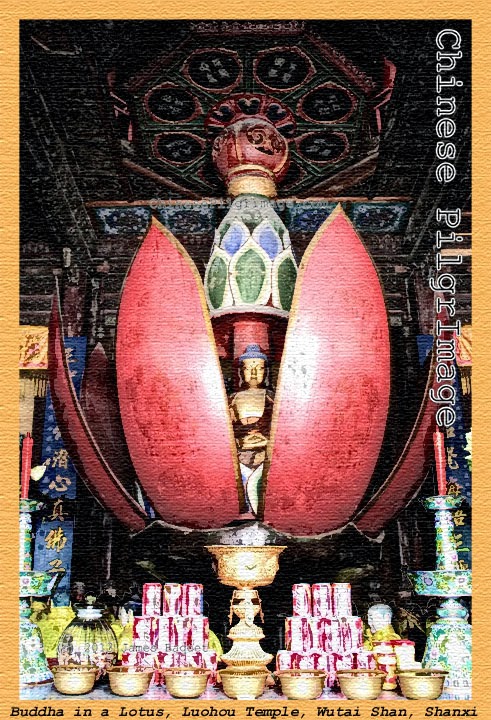
Luohou Temple (罗喉寺) on Wutai Shan in Shanxi (山西, 五台山) is
famed for this Buddha in a mechanical lotus that opens and closes.

August 27, 2012 - The lower gate of Luohou Temple is located immediately next to Shifang Tang, which I described in a previous article.

EXTRA: Longxing Temple, Zhengding, Hebei

(This article was published in the Shenzhen Daily on June 8, 2015.)

Buddhas (佛) in the exquisite collection at Longxing Temple (隆兴寺), Zhengding, Hebei (河北, 正定).

September 3, 2012 - On the final touring day of my two-week trip (indeed, the final day of my Chinese pilgrimage so far--but I didn't know at the time that it would be), I again visited an outlying area of Shijiazhuang, capital of Hebei Province. This time I went to Zhengding, where the Shijiazhuang Zhengding International Airport (out of which I would be flying) is also located.

EXTRA: Beishan Grottoes, Dazu, Chongqing

(This article was published in the Shenzhen Daily on March 24, 2014.)

An elegant Buddha Triad (三尊佛) at Beishan Grottoes (北山石窟) near "downtown" Dazu, Chongqing (重庆, 大足).
June 18, 2012 - After the somewhat cartoonish figures at Baodingshan, I found the elegance of the next set of grottoes refreshing.

EXTRA: Longmen Grottoes, Luoyang, Henan

(This article was published in the Shenzhen Daily on December 9, 2013.)

Colossal Vairocana Buddha (毗卢遮那佛) at Longmen Grottoes (龙门石窟) in Luoyang, Henan (河南, 洛阳市).
It's said that this is the face of Wu Zetian (武则天), the empress who paid for much of the carving.
November 2, 2011 - Longmen is considered one of the three "Top Buddhist Grottoes" in China, and was the first of these that I visited. It is considered by some to be the best of the three. (I still have not been to Mogao/Dunhuang, but I have seen Yungang at Datong.)

EXTRA: Nan Shaolin Temple, Putian, Fujian

(This article was published in the Shenzhen Daily on November 25, 2013.)

This Laughing Buddha (弥勒佛) sits in the Heavenly Kings' Hall (天王殿)
at Nan Shaolin Temple (南少林寺), Putian, Fujian (福建, 莆田市).
October 29, 2011 - After visiting three temples in a day, I was planning to sleep late, write up my notes, and slowly make my way back to Fuzhou and my flight home. Alternatively, if I had the energy, I might have visited the Tian Hou/Mazu temple on a nearby island, the site of that Daoist sea-goddess's birth.

But as happened before, my friend Venerable Deru had other plans for me. He had arranged for a friend to come pick me up and take me to Nan Shaolin Temple. After he had nagged me about this for days, saying, "It's very historic," I told him that if I tried to go to every "historic" temple in China, I'd be dead before I finished!

No. 78: Guanghua Temple, Putian, Fujian

(This article was published in the Shenzhen Daily on November 4, 2013.)

These small Buddhas (佛) are on the side of a small pagoda (塔)
at Guanghua Temple (广化寺), Putian, Fujian (福建, 莆田市).
October 28, 2011 - It took quite a while--over an hour--to catch a taxi from the more remote Cishou Temple, but once I did, it was a relatively short ride to my second temple of the day, Guanghua Temple.

No. 73: Xichan Temple, Fuzhou, Fujian

(This article was published in the Shenzhen Daily on September 16, 2013.)

A statue of Vairocana Buddha (毗卢遮那佛) at Xichan Temple (西禅寺), Fuzhou, Fujian (福建, 福州市).
October 24, 2011 - It was nearly 4 p.m. when I reached Xichan ("Western Zen") Temple, but although the halls would close around 6, the grounds would stay open until 7:30!

No. 65: Dafo Temple, Xinchang, Zhejiang

(This article was published in the Shenzhen Daily on July 22, 2013.)

Great Buddha (大佛) at Dafo Temple (大佛寺), Xinchang County, Zhejiang (浙江, 新昌县)
September 12, 2011 - My next trip was to several temples in Zhejiang. It was the first (and so far only) time that I traveled with anyone besides my wife. My companion on this trip was an Indian friend I'll call "Mr. Deep."

From Ningbo, we took a bus to rural Xinchang County and Dafo (Great Buddha) Temple. The temple itself is located in the Great Buddha Scenic Area, comprised of over 25 square kilometers of mountain scenery, grottoes, and historic architecture.

No. 54: Yonghe Gong Temple, Beijing

(This article was published in the Shenzhen Daily on April 15, 2013.)

The Longevity Buddha (长寿佛) is in a pagoda (塔) inside a hall
(殿) at Yonghegong ("Lama")  Temple (雍和宫), Beijing (北京)
July 12, 2011 - Beijing's Yonghe Gong--"The Palace of Peace and Harmony"--is nothing short of stunning. Set in the midst of the city on a huge piece of land (nearly a half-kilometer in length) it can absorb thousands of visitors and still maintain its signature atmosphere of tranquility.